Go to the emergency room now if you have a known or suspected stone and a fever or chills, pain you can’t control, or vomiting that keeps you from holding down fluids. A stone that blocks an infected kidney is an emergency.
What a stone feels like
Most stones cause no trouble while they sit in the kidney. Pain starts when a stone moves into the ureter, the narrow tube between the kidney and the bladder, and blocks the flow of urine. Common signs are:
- Sudden, severe pain in the side or back, often moving toward the groin
- Pink, red or brown urine
- Nausea and vomiting
- Needing to urinate often, or burning when you do
Some stones are found by accident on a scan done for something else. Those are worth a visit too, because a stone that is not causing pain today can still grow or move.
How Dr. Su decides on treatment
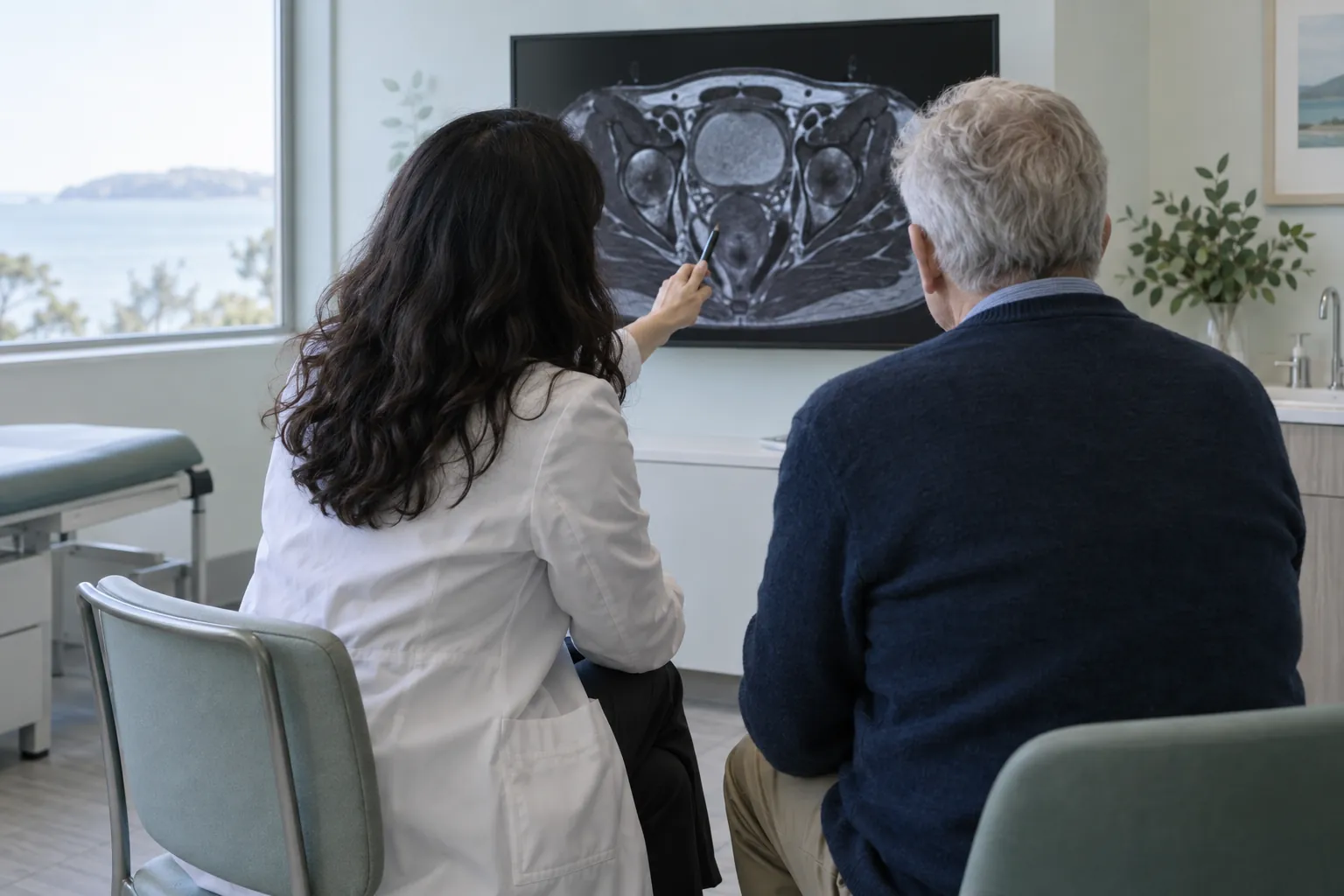
At your first visit she reviews your chart and your imaging with you. The size of the stone, where it is, how dense it is, and how your kidney is draining all shape the choice. Many small stones pass on their own with time, fluids and medication. When a stone is too big to pass, keeps causing pain or is blocking the kidney, she removes it.
Surgical options
Ureteroscopy
A thin scope is passed up through the bladder to reach the stone, which is broken up with a laser and removed. Best for smaller kidney stones and stones in the ureter.
Shockwave lithotripsy (ESWL)
Sound waves are focused on the stone from outside the body and break it into pieces small enough to pass. An option for kidney stones under 1.5 cm.
Percutaneous nephrolithotomy (PCNL)
A small tunnel is made through the back straight into the kidney to break up and remove large stones, usually those over 2 cm.
Robotic pyelolithotomy
For select large stones, especially when the kidney’s drainage also needs repair, the stone is removed robotically through a few small incisions.
After a stone
Without prevention, about half of people who form one stone form another within ten years. Once your stone is treated, Dr. Su can have it analyzed and talk with you about lowering the chance of the next one. For many people that starts with drinking more water every day.
Questions patients ask
Will I need a stent?
Often, after ureteroscopy. A stent is a soft, thin tube that keeps the kidney draining while the ureter heals. It usually stays in for a few days to a couple of weeks and is removed in the office.
Is stone surgery an overnight stay?
Ureteroscopy and shockwave lithotripsy are usually outpatient, so you go home the same day. PCNL and robotic surgery typically involve a hospital stay.
What should I bring to my first visit?
Your CT scan or ultrasound report, and the images on a disc if you have them. Also bring a list of your medications and any urine test results.