Three ways to operate
Most operations below are done one of three ways. Dr. Su recommends the approach that fits your condition and your body, and she explains why before you decide.
Robotic
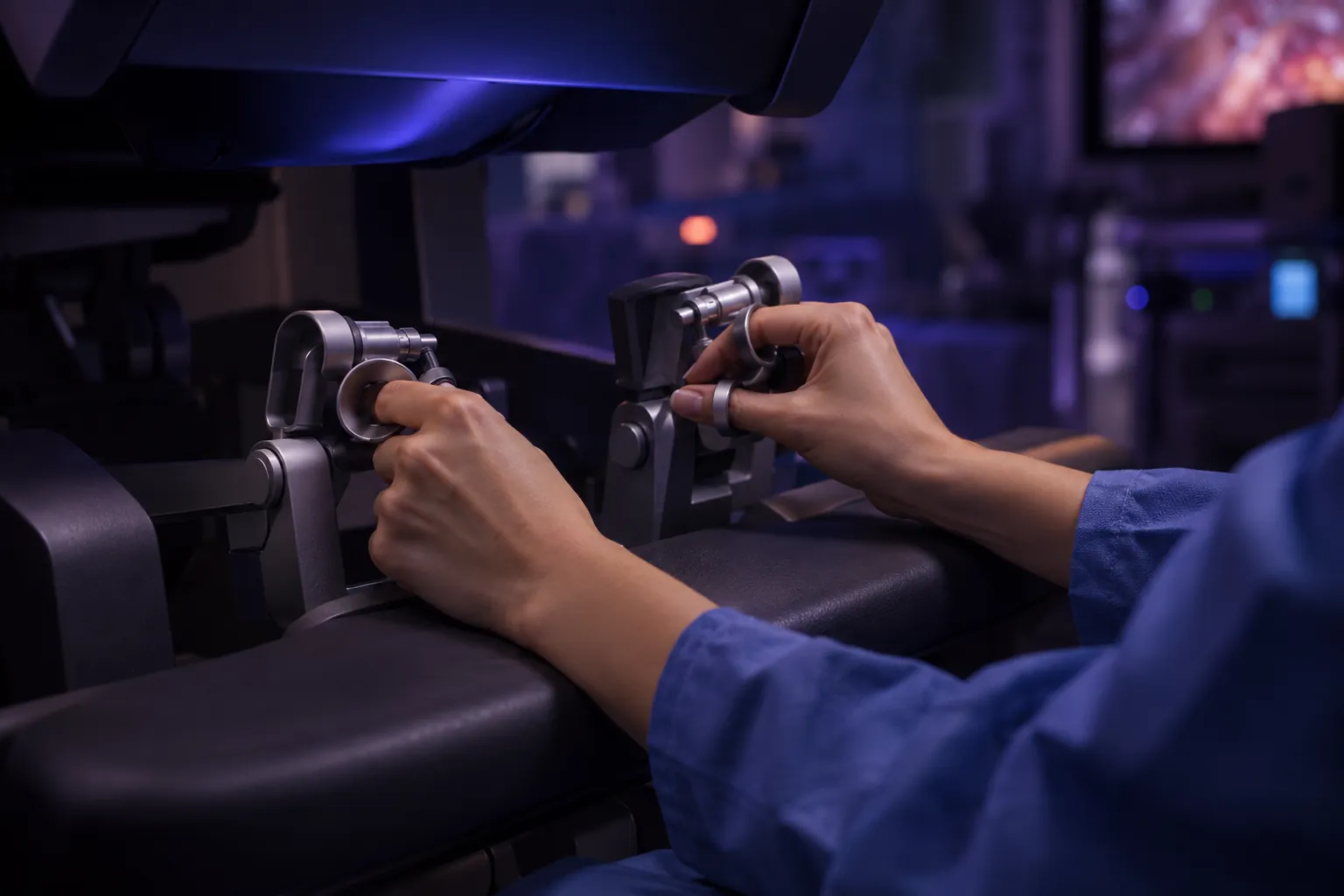
Dr. Su sits at a console and controls thin instruments and a 3D camera placed through small incisions. Compared with open surgery, this usually means less pain, less blood loss and a shorter hospital stay.
Endoscopic
A thin scope is passed through the urethra, the tube urine leaves the body through, to reach the prostate, bladder, ureter or kidney.
Open
A traditional incision, used when it is the better way to do a particular operation, such as placing an artificial urinary sphincter or a sling.
Prostate
Robotic
- Robotic-assisted radical prostatectomy, with or without pelvic lymph node dissection. Removes the whole prostate to treat prostate cancer, along with nearby lymph nodes when the extent and grade of the cancer call for it.
- Robotic-assisted simple prostatectomy. For a very large enlarged prostate. Removes only the inner part of the prostate that blocks urine, not the whole gland.
Endoscopic
- Transurethral resection of the prostate (TURP). Removes the prostate tissue that blocks urine flow, using an electric loop passed through the urethra.
- Aquablation. A robot-guided, heat-free waterjet removes the prostate tissue that is causing symptoms, following a map Dr. Su plans with live ultrasound.
Kidney
- Robotic-assisted nephrectomy, partial or radical. Surgery for a kidney tumor. A partial nephrectomy removes only the tumor and saves the rest of the kidney. A radical nephrectomy removes the whole kidney.
- Robotic-assisted nephroureterectomy. Removes a kidney together with its ureter, the tube that carries urine to the bladder. It is usually done for cancer that starts in the lining of the kidney’s drainage system or the ureter.
- Percutaneous nephrolithotomy (PCNL). A small tunnel is made through the back into the kidney to break up and remove large stones, usually those over 2 cm.
- Shockwave lithotripsy (ESWL) of the kidney. Shock waves aimed from outside the body break a kidney stone into pieces small enough to pass. For kidney stones under 1.5 cm.
Bladder
- Cystoscopy under anesthesia (CUA). A look at the inside of the bladder and urethra with a thin camera while you are under anesthesia.
- Transurethral resection of bladder tumor (TURBT). Removes a bladder tumor through the urethra, with no incision. The tissue goes to a pathologist, who finds out what kind of tumor it is and how deep it goes.
- Cystolithopaxy. Breaks up bladder stones with a scope passed through the urethra and removes the pieces.
- Suprapubic tube. A catheter placed through the lower belly straight into the bladder, to drain urine over the long term.
- Bladder hydrodistention. The bladder is gently stretched by filling it with fluid while you are under anesthesia. It is used to evaluate and treat bladder pain syndrome (interstitial cystitis).
Ureter
Robotic
- Robotic-assisted pyeloplasty. Repairs a narrowing where the kidney drains into the ureter, called a ureteropelvic junction (UPJ) obstruction, so urine can flow freely again.
- Robotic-assisted ureteral reimplant. Reattaches the ureter to the bladder in a new spot, for example when the lower end of the ureter is narrowed or damaged.
Endoscopic
- Cystoscopy with ureteral stent. Places a stent, a soft, thin tube, from the kidney to the bladder to keep urine draining past a blockage.
- Ureteroscopy for a stone or a filling defect. A thin scope is passed up into the ureter or kidney to remove a stone. It is also used to look at a filling defect, a spot on a scan where something blocks the contrast dye. A filling defect can be a stone, a blood clot or a tumor, and ureteroscopy can show which.
Penis
- Adult circumcision. Removes the foreskin. It is often done when phimosis (a tight foreskin) or balanitis (inflammation of the head of the penis) keeps coming back after treatment with medication.
- Penile lesion biopsy or ablation. Takes a small sample of a spot or growth on the penis to find out what it is, or removes it.
- Implantable penile prosthesis, malleable, 2-piece or 3-piece. A device placed inside the penis for erectile dysfunction that has not responded to other treatments. The 2-piece and 3-piece implants are inflatable and use a small pump hidden in the scrotum. A malleable implant is bendable.
Scrotum
- Vasectomy. Permanent birth control. Dr. Su uses the no-scalpel technique and does most vasectomies in the clinic under local anesthesia.
- Hydrocelectomy. Removes a hydrocele, a sac of fluid around the testicle that makes the scrotum swell.
- Orchiectomy, simple or radical. Removal of a testicle. A radical orchiectomy, done through a small cut in the groin, is the main surgery for testicular cancer.
- Epididymectomy or spermatocelectomy. Removes the epididymis (the coiled tube behind the testicle where sperm mature) or a spermatocele, a fluid-filled cyst that grows from it.
- Scrotal exploration for torsion. Emergency surgery to untwist a twisted testicle and stitch it in place so it can’t twist again.
- Subinguinal varicocele ligation. Ties off the enlarged veins above the testicle (a varicocele) through a small incision just below the groin.
- Spermatic cord lysis (skeletonization). A procedure for long-lasting testicle pain. It strips the small nerves and tissue away from the spermatic cord, the bundle that carries blood vessels and the vas deferens to the testicle.
Go to the emergency room now if pain in a testicle starts suddenly, especially with swelling, nausea or vomiting. This can be torsion, and it needs surgery within hours to save the testicle.
Urethra
Open
- Artificial urinary sphincter. An implanted cuff around the urethra that you open with a small pump in the scrotum when you want to urinate. It is used for men with significant leakage, often after prostate surgery.
- Male sling. A strip of mesh placed under the urethra to support it and reduce leakage in men, often after prostate surgery.
- Female mid-urethral sling. A narrow strip of mesh placed under the middle of the urethra to stop leaking when you cough, laugh or exercise (stress incontinence).
- Urethral diverticulectomy. Removes a urethral diverticulum, a small pouch off the urethra that can collect urine and cause infections or pain.
Endoscopic
- Cystoscopy with bulking agent injection. A gel such as Bulkamid is injected into the wall of the urethra through a scope, to help it close and reduce stress incontinence.
- Direct vision internal urethrotomy or laser urethrotomy. Opens a urethral stricture, a scar that narrows the urethra, by cutting it from the inside with a small blade or a laser passed through a scope.
Other procedures
Some treatments are described on the condition pages instead:
- UroLift, Rezūm and GreenLight laser for BPH
- MRI-ultrasound fusion prostate biopsy
- Robotic pyelolithotomy for large stones
- Bladder Botox and InterStim
Dr. Su does not fit pessaries or perform pelvic organ prolapse surgery, including sacrocolpopexy.
Scheduled for surgery?
Start with the pre-operative instructions. You will need a work-up with your primary care provider within 30 days of your surgery and at least 2 days before it, so all the paperwork arrives in time.
Questions patients ask
Will I stay in the hospital overnight?
It depends on the operation. Some are outpatient, so you go home the same day. Robotic partial nephrectomy, robotic simple prostatectomy and TURP usually involve one night in the hospital. Aquablation is usually a same-day procedure, with an overnight stay only sometimes. Dr. Su will tell you what to expect for your surgery.
Where will my surgery take place?
At one of the hospitals where Dr. Su has privileges: Cedars-Sinai, Providence Saint John’s, Good Samaritan, Hollywood Presbyterian, Glendale Adventist, Glendale Memorial and Long Beach Memorial. Which one can depend on the procedure and your insurance plan. Most vasectomies are done in the clinic.
Why robotic surgery instead of open surgery?
When it is a good fit, robotic surgery usually means smaller incisions, less pain, less blood loss and a shorter hospital stay. It is not right for everyone. Extensive past abdominal surgery, bleeding problems and serious heart or lung disease can all change the recommendation.
My procedure isn’t listed. Does Dr. Su do it?
This page covers many, but not all, of the surgeries she performs. Call the office where you are seen and ask.