
Getting a call about a high PSA can be unsettling, and many men assume it means cancer. Often it does not. PSA is a useful early warning, but it rises for many reasons.
What is PSA?
PSA stands for prostate-specific antigen. It is a protein made by the prostate, the walnut-sized gland below the bladder that helps make semen. A small amount of PSA normally gets into the blood, and a simple blood test measures it.
There is no single number that is normal for every man. PSA tends to rise with age and with the size of the prostate, so Dr. Su looks at more than one result, along with your family history and exam.
Why can PSA be high if it isn’t cancer?
Anything that enlarges or irritates the prostate can push PSA up. Common reasons include:
- An enlarged prostate. Benign prostatic hyperplasia (BPH) is a noncancerous growth of the prostate that is common as men age. A bigger gland usually makes more PSA.
- Infection or inflammation. Prostatitis (inflammation of the prostate) or a urinary tract infection can raise PSA, sometimes for weeks.
- Recent ejaculation. This can raise PSA a little for a short time.
- Long bike rides. Pressure on the area between the scrotum and the anus may raise PSA briefly in some men, though the effect is usually small.
- Recent procedures. A urinary catheter, a cystoscopy (a look inside the bladder with a thin camera) or a prostate biopsy can raise PSA for a while.
Some medicines work the other way. Finasteride and dutasteride, which are used for an enlarged prostate or for hair loss, can lower PSA by roughly half. If you take one of them, make sure your doctor knows, because your result needs to be read differently.
Should I repeat the test?
Usually, yes. PSA can vary from one test to the next, and a single high reading is often lower the second time. Urology guidelines recommend repeating a newly high PSA before moving on to further tests or a biopsy.
Before the repeat test, many urologists suggest avoiding ejaculation and long bike rides for a couple of days. If a urine test shows an infection, it is treated first, and the PSA is checked again some weeks later.
The trend matters too. A PSA that keeps climbing over several tests is more concerning than one high value that settles back down.
The short version: a high PSA is a reason to look more closely, not a diagnosis. The usual path is a repeat test, then a blood or urine marker test or an MRI if needed, and a targeted biopsy only when the results point that way.
What are the blood and urine tests that come after PSA?
If your PSA is still high, a second test can help sort out whether a biopsy makes sense. These tests look for markers in the blood or urine linked to significant prostate cancer, meaning cancer that could grow or spread if left alone. Tests Dr. Su may use include:
- 4Kscore and IsoPSA, which are blood tests
- SelectMDx and ExoDx, which are urine tests
Each one estimates your chance of having a significant cancer. A low result can support holding off on a biopsy, and a higher one makes a closer look more worthwhile. The goal is to avoid biopsies that are not needed. Not every test fits every man, and insurance coverage varies, so Dr. Su will suggest the one that makes sense for you.
What does a prostate MRI show?
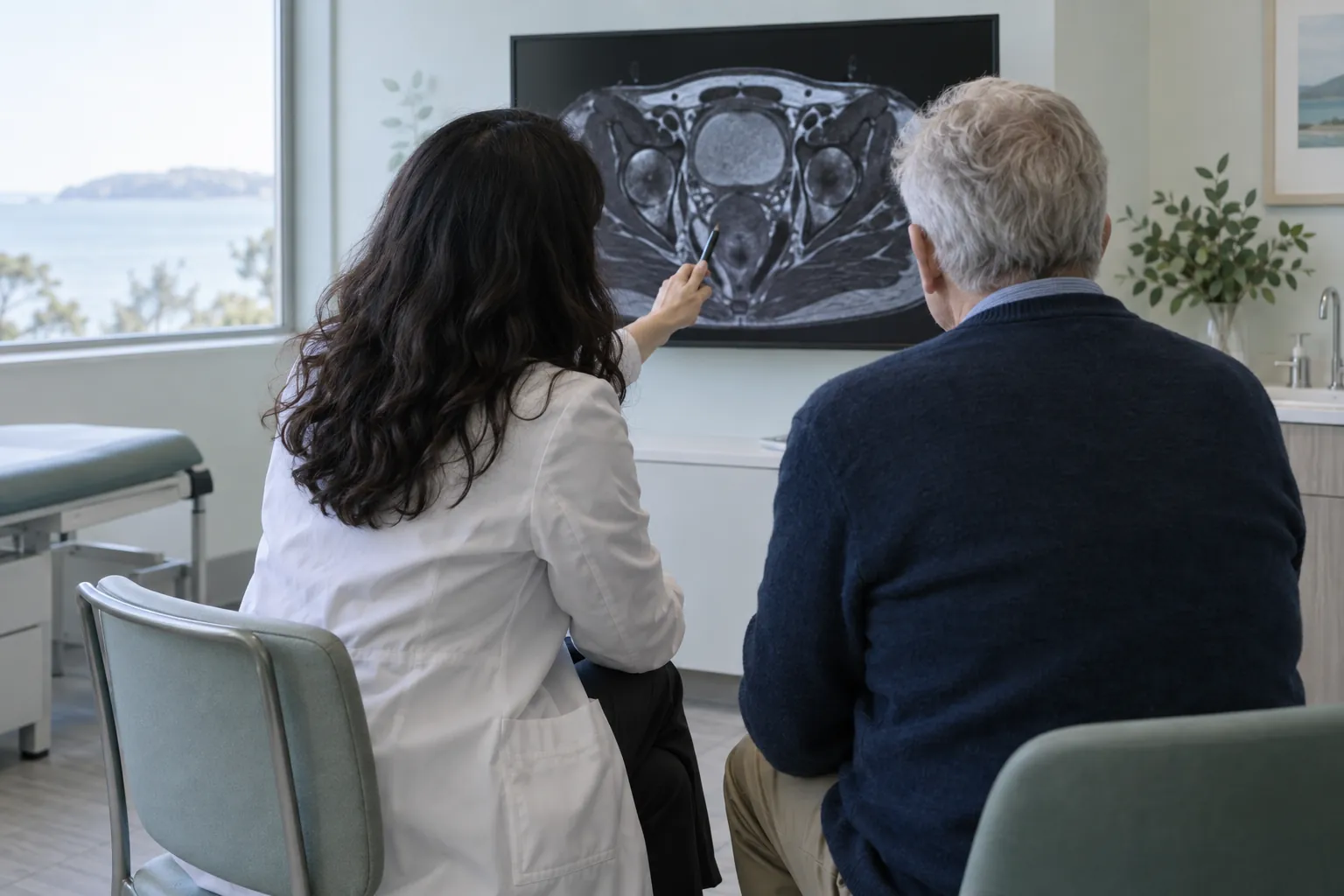
A prostate MRI uses a strong magnet, not radiation, to make detailed pictures of the gland. It can show areas that look suspicious and help decide whether a biopsy is needed and where to aim it. The scan usually takes under an hour, and it often includes contrast dye given through a vein in your arm.
A radiologist, a doctor who specializes in reading scans, grades each suspicious area on a 1 to 5 scale called PI-RADS (Prostate Imaging Reporting and Data System):
- PI-RADS 1 or 2: a significant cancer is unlikely.
- PI-RADS 3: uncertain. The area could go either way.
- PI-RADS 4 or 5: a significant cancer is likely, and a biopsy is usually recommended.
A PI-RADS score describes likelihood, not a diagnosis. A low score is reassuring but does not rule out cancer completely, and a high score does not prove cancer. For a PI-RADS 3 area, the decision often depends on other factors, such as your PSA density (your PSA compared with the size of your prostate). Only a biopsy can confirm cancer.
How does an MRI-ultrasound fusion biopsy work?
If a biopsy is recommended, Dr. Su performs MRI-ultrasound fusion biopsy. During the biopsy, software lays your MRI over a live ultrasound picture of the prostate, so the needle can be aimed at the areas that looked suspicious. Samples are often taken from other parts of the prostate too, in case of a cancer the MRI did not show.
The office will give you instructions ahead of time, which may include an antibiotic and an enema. Afterward, it is common to see some blood in your urine or stool for a few days, and in your semen for several weeks.
After a biopsy, call the office or go to the emergency room right away if you get a fever or chills, or if you cannot urinate. An infection after a biopsy needs prompt treatment.
What do the biopsy results mean?
A pathologist, a doctor who examines tissue under a microscope, checks each sample. If cancer is found, the report gives a Gleason score and a Grade Group from 1 to 5. These describe how abnormal the cells look, which helps predict how the cancer will behave. Grade Group 1 (a Gleason score of 6) is the lowest grade and tends to grow slowly. Higher Grade Groups are more aggressive.
Dr. Su combines the grade with your PSA, MRI, exam and how many samples contained cancer to place it in a risk group (low, intermediate or high). That risk group, along with your health and your priorities, guides the options.
If no cancer is found, that is good news. Your PSA will usually still be followed, because a biopsy samples only part of the prostate.
Does low-risk prostate cancer need treatment right away?
Often, no. Many low-risk prostate cancers grow so slowly that they may never cause harm. For most men with low-risk cancer, national guidelines recommend active surveillance. This means watching the cancer closely with regular PSA tests, plus repeat MRIs and biopsies on a schedule, and starting treatment only if the cancer shows signs of growing or becoming more aggressive.
Active surveillance is not doing nothing. It is a plan with regular checkups that lets many men avoid or delay the side effects of treatment, such as leaking urine or erection problems.
For cancers that do need treatment, options include robotic prostatectomy (surgery to remove the prostate), radiation, focal therapy that treats only part of the prostate (such as HIFU or TULSA, which use ultrasound energy) and hormone therapy. The prostate cancer page explains each one.
Questions patients ask
Does a high PSA mean I have prostate cancer?
Not necessarily. An enlarged prostate, inflammation, infection and other things can raise PSA. A high result is a reason for a careful look before any decision about a biopsy.
Can I lower my PSA before the repeat test?
The goal is an accurate reading, not a lower one. Avoiding ejaculation and long bike rides for a couple of days, and treating any infection first, helps make the result reliable. Do not start a supplement or medicine to change your PSA without asking your doctor.
Does a prostate biopsy hurt?
Most men describe pressure and brief discomfort rather than sharp pain. The area is numbed, and some biopsies are done with sedation (medicine that makes you relaxed or sleepy). Dr. Su will explain what to expect.
What should I bring to my first visit?
All of your PSA results with their dates, any MRI or biopsy reports, and a list of your medicines, including finasteride or dutasteride.
If you’d like Dr. Su to look at your results, book a visit or call the office nearest you. She sees patients in Long Beach, Koreatown and Beverly Grove.