
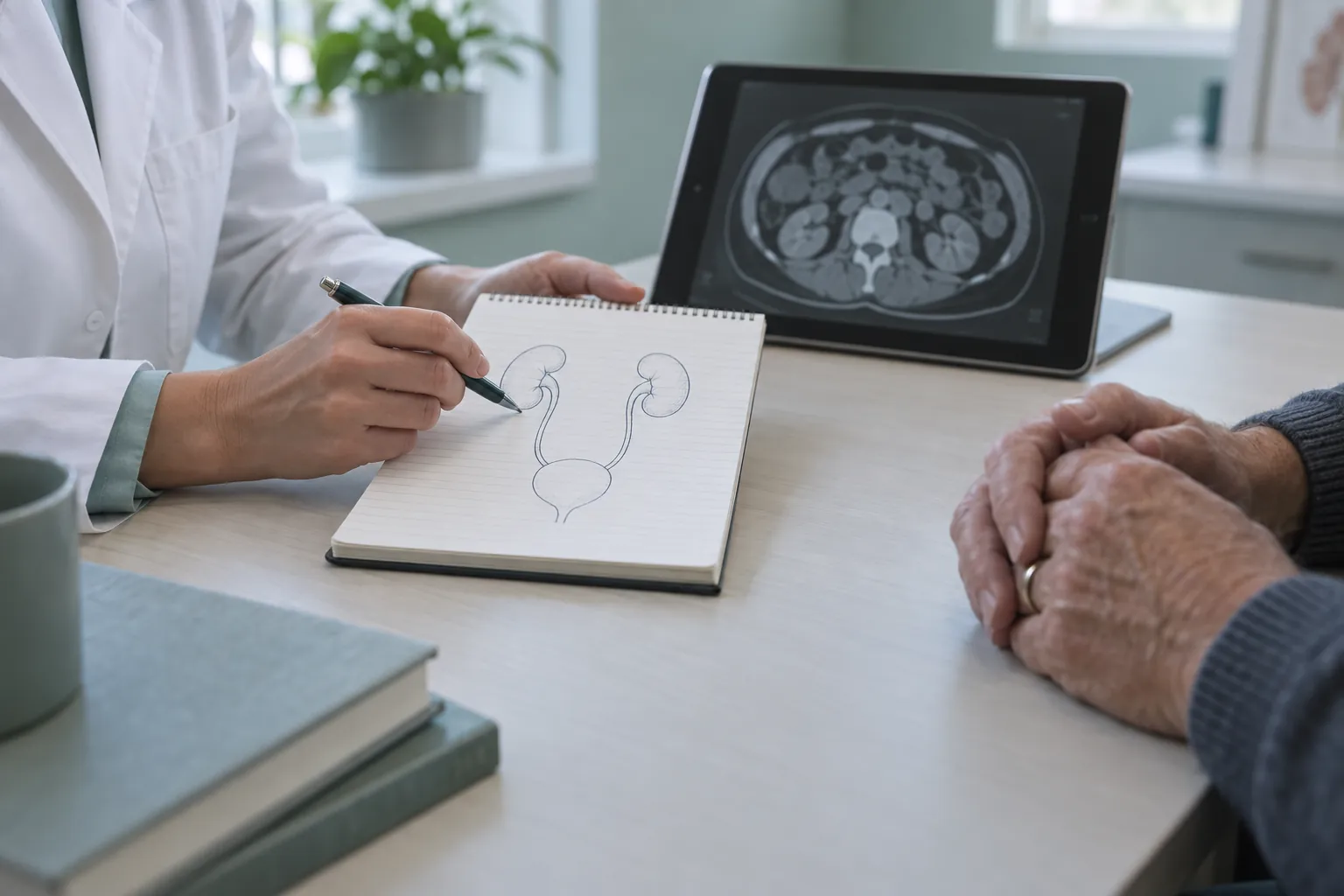
You had a CT scan or an ultrasound for back pain, a stomach problem or a checkup, and the report mentions a “renal mass” or a “kidney lesion.” (Renal simply means kidney.) It is natural to fear the worst. But finding something on the kidney this way is common, and the first step is almost never surgery. It is getting the right information.
Why was this found by accident?
Scans are used so often today that many kidney findings turn up by chance. Doctors call these incidental findings. Most kidney cancers are now found this way, before they cause any symptoms. That is often good news, because a mass found early is usually smaller and easier to treat.
Is it a cyst or a solid mass?
This is the first big question, and the answer changes everything that follows.
A cyst is a pocket of fluid. Simple kidney cysts are very common, especially as people get older, and they are harmless. They usually need no treatment and no follow-up.
Some cysts are complex, meaning they have thick walls, thin inner dividing walls or solid areas. Radiologists (doctors who specialize in reading scans) grade cysts with a system called the Bosniak classification. The lowest grades are benign, meaning not cancer. A middle grade is usually watched with repeat scans. The highest grades are more likely to contain cancer and are often managed like a solid mass.
A solid mass is made of tissue rather than fluid. Solid masses are more likely to be cancer, most often renal cell carcinoma, the most common type of kidney cancer in adults. But solid does not automatically mean cancer. Some are benign growths, such as an oncocytoma or an angiomyolipoma (a growth that contains fat, which can often be recognized on a CT scan).
How worried should I be about a small mass?
Size matters. Doctors often call a solid mass of about 4 centimeters (roughly an inch and a half) or less a small renal mass. A fair share of these turn out to be benign, and studies often put it at around 1 in 5. Many of the small masses that are cancer grow slowly, often only a few millimeters a year, and they rarely spread while they are small.
That is why a small kidney mass is usually not an emergency. You have time to get the right tests and think through your options. It is still important to follow through, because some small masses do grow, and the right plan depends on details that only better imaging can show.
The key point: a kidney mass is a finding, not a diagnosis. Many are harmless, and many small kidney cancers grow slowly. The next step is usually better imaging and a conversation, not an operation.
What extra tests might I need?
The scan that found the mass was often not set up to look at the kidney in detail. Dr. Su may order:
- A CT scan with contrast. Contrast is a dye given through a vein. Pictures taken before and after the dye show whether the mass takes up blood flow, which is a sign of solid tissue.
- An MRI, if you cannot have CT contrast, or to take a closer look at a complex cyst.
- An ultrasound, which is often enough to confirm a simple cyst.
- Blood and urine tests, such as a urinalysis, a complete blood count and a metabolic panel that checks your kidney and liver function.
- Chest imaging, if the mass looks like cancer, to check that nothing has spread.
Sometimes a biopsy helps. A thin needle is passed through the skin, guided by imaging, to take a small sample of the mass. It is not needed for everyone. It is most useful when the result would change the plan, for example when deciding between watching a small mass and treating it.
At your visit, Dr. Su reviews all of your images with you and goes over your options in detail.
What are my options?
The right choice depends on the size and location of the mass, what the imaging shows, your kidney function, your age and your overall health. The main options are:
Active surveillance
Regular scans to watch the mass, usually every few months at first and less often if it stays stable. Treatment starts if it grows quickly or changes. Often a reasonable choice for small masses, and for people whose other health problems make surgery riskier.
Thermal ablation
A needle guided by imaging destroys the mass by freezing it (cryoablation) or heating it (radiofrequency or microwave ablation). Generally used for small masses, often in people who are not good candidates for surgery. An interventional radiologist performs it, and Dr. Su arranges the referral and follows you afterward.
Partial nephrectomy
Surgery that removes only the tumor, with a small rim of normal tissue, and leaves the rest of the kidney in place and working. When it is possible, this is the approach Dr. Su favors.
Radical nephrectomy
Removal of the whole kidney along with the tumor. Used when the tumor has replaced most of the kidney, or sits where the kidney’s blood supply cannot be preserved.
If a cancer has spread beyond the kidney, treatment may also include medicines such as targeted therapy or immunotherapy. Dr. Su works closely with medical oncologists (doctors who treat cancer with medicine) when that is needed.
Why does Dr. Su try to save the kidney?
Your kidneys filter waste from your blood and help control your blood pressure. You can live well with one healthy kidney, but keeping as much kidney function as possible matters over the long run. That is especially true if you have diabetes, high blood pressure or other conditions that strain the kidneys. A small number of people also develop another tumor later, in either kidney.
For small tumors, removing only the tumor generally controls the cancer about as well as removing the whole kidney, while leaving you with more kidney function. That is why, when possible, Dr. Su removes just the tumor with a partial nephrectomy.
In suitable patients she does this robotically, with the da Vinci surgical system, through a few small incisions instead of one large one. Patients are typically in the hospital overnight and return to most activities within 1 to 2 weeks. They avoid heavy lifting and strenuous exercise for about 4 weeks so the incisions and the kidney can heal. In rare cases an open operation is needed, with a hospital stay of about 3 to 5 days. The kidney cancer page has more detail.
While you wait for tests, call the office if you see blood in your urine or have new pain in your side.
Questions patients ask
Can a kidney mass be cancer if I feel fine?
Yes. Most kidney masses, including most kidney cancers, cause no symptoms and are found by chance. Feeling well does not tell you either way, which is why the mass needs proper imaging.
Is it safe to wait a few weeks for more tests?
For most small masses, yes. Taking a few weeks to get the right scan usually does not change the outcome. What matters is not letting it drift for months without a plan.
Do I need a biopsy before surgery?
Not always. When the imaging clearly shows a solid mass that should come out, a biopsy may not change the plan. A biopsy is more helpful when the result would change what you do, such as choosing between surveillance, ablation and surgery.
Can I live normally with one kidney?
Most people with one healthy kidney live normal, active lives. Your doctors will check your kidney function and blood pressure over time.
If you’d like Dr. Su to look at your results, book a visit or call the office nearest you. Bring the report and, if you have it, a disc with the images from your scan.